
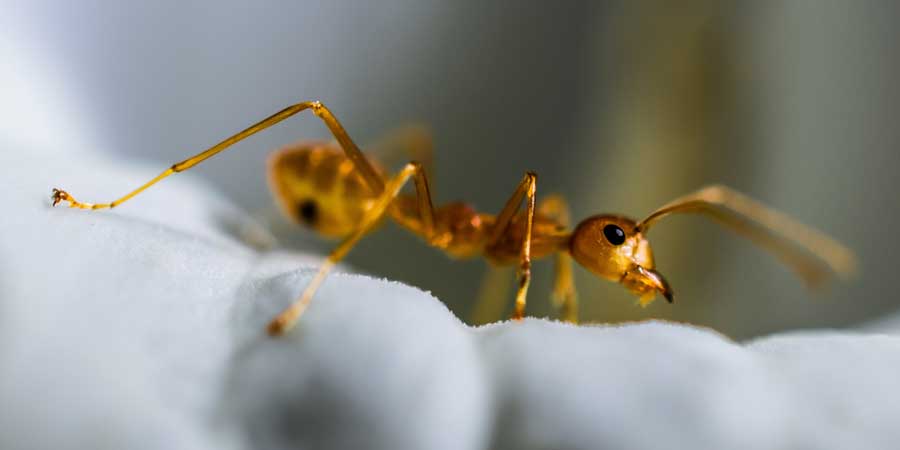
Fire Ants
Fire ants (primarily Solenopsis invicta and related species) are aggressive stinging ants known for painful, sometimes dangerous stings and mound-building behavior. They can damage lawns, landscapes, agricultural areas, and interfere with outdoor activities. Rapid colony expansion and the ability to rebuild after disturbance make them a significant nuisance and public-health concern in affected regions.
Identification:
Worker fire ants are typically 1/8 to 1/4 inch long and range from reddish-brown to dark brown or black. Colonies contain polymorphic workers of varying sizes, winged reproductive males and queens during mating flights, and a single or multiple queens depending on the species and colony type. Fire ant mounds are often dome-shaped, lacking a central opening, and can range from a few inches to over a foot across.
Behavior:
Fire ants prefer sunny, open, well-drained areas such as lawns, parks, pastures, roadsides, and agricultural fields, but they also appear in landscaped beds and disturbed soils. Colonies build soil mounds around nest chambers and forage widely from the mound at dawn and dusk. When a mound is disturbed, workers aggressively swarm and sting, delivering multiple painful stings that can cause allergic reactions in sensitive individuals. Fire ants can relocate nests, form satellite colonies, and colonize new areas via nuptial flights or human-mediated movement of soil and plant material.
Fire ants are omnivorous and opportunistic feeders, consuming live and dead insects, small vertebrates, seeds, plant juices, honeydew produced by sap-feeding insects, and human food waste. Their foraging can damage young plants and seedlings, and their predation can impact beneficial ground-dwelling insects and ground-nesting wildlife.
Mating and Life Cycle:
Fire ant colonies reproduce both by nuptial flights—winged males and queens mate in the air, after which queens establish new colonies—and by budding, where a queen and workers split off to form a satellite nest. Queens lay eggs that develop into larvae, pupae, and workers; a mature colony may contain tens of thousands of workers. Development time from egg to adult varies with temperature and food availability but typically takes several weeks. Some species or colony forms may have multiple queens, leading to faster population growth and more resilient infestations.
What you can do:
Reduce fire ant problems by minimizing conditions that favor colony establishment. Keep lawns healthy and well-drained, avoid prolonged bare soil areas, and promptly repair irrigation or drainage issues. Inspect and clean up soil, mulch, potted plants, and landscape materials before bringing them onto your property to avoid introducing colonies. Reduce food sources by securing garbage, pet food, and compost bins. When performing outdoor work, check soil and potted plants for mounds and treat or relocate infested materials. Use caution around mounds—disturbing them can provoke aggressive stinging.
What we do:
Professional pest control providers offer inspection and tailored treatment plans that may include broadcast baiting with slow-acting granular or toxicant baits to target foraging workers and eliminate colonies from within. For immediate mound suppression, technicians may apply contact insecticides as drenches, dusts, or localized sprays directly to mounds, though these often require follow-up baiting to address satellite colonies. Integrated approaches combine perimeter and site-wide baiting, targeted mound treatments, habitat modification recommendations, and ongoing monitoring. Commercial applicators also advise on timing (baiting is most effective when ants are actively foraging) and safety precautions to protect people, pets, and beneficial insects.
When to call us:
Contact us when mounds are numerous or located near play areas, utility equipment, livestock, or high-traffic locations; when stings cause allergic reactions or health concerns; or when do-it-yourself measures fail to control populations. Professionals can implement broad-area baiting strategies, treat difficult or hazardous sites safely, and provide follow-up to ensure long-term control.
For expert inspection and customized fire ant control solutions, contact our licensed pest control team today to protect your property, family, and livestock from fire ant threats.
For more information:
Pharaoh Ants
Pharaoh ants (Monomorium pharaonis) are small, yellowish to light brown ants typically 1/16 to 1/12 inch long. They are highly adaptable indoor pests that thrive in warm, humid buildings and are common in hospitals, multifamily housing, restaurants, and other food-handling or climate-controlled facilities. Because colonies readily split into many satellite nests, infestations can spread quickly and be difficult to eradicate without a coordinated approach.
Identification:
Adult Pharaoh ants are tiny (about 2 mm long), pale yellow to light brown, with slightly darker abdomens. Workers are monomorphic (similar size) and lack a sting, though they can bite. Winged reproductives (alates) appear during mating flights. Because of their small size and coloration, Pharaoh ants are often mistaken for other small ant species; careful inspection of size, color, and behavior helps with correct identification.
Behavior:
Pharaoh ants prefer warm, humid, protected indoor environments and nest in wall voids, behind baseboards, under floors, in electrical outlets, insulation, appliance cavities, and within furniture. Outdoors they may nest under stones or mulch in warmer climates but most problems arise inside heated buildings where they find reliable food and moisture. Colonies exhibit polydomy (many satellite nests) and readily bud—splitting off small groups with a queen—which makes disturbance (such as improper insecticide spraying) likely to cause colony fragmentation and spread.
Pharaoh ants are omnivorous and opportunistic feeders. They prefer sweet foods—sugars, syrups, honeydew—but will also consume proteins, grease, meats, and dead insects. In institutional settings they are a serious contamination risk because they forage in kitchens, food storage areas, drains, and even medical areas, where they can transfer pathogens picked up from unsanitary sites.
Mating and Life Cycle:
Pharaoh ant colonies reproduce by budding: groups of workers and one or more queens split from the parent colony to form satellite nests. Alate flights can occur under favorable conditions, but budding is the primary mode of spread in buildings. Queens lay eggs that develop into larvae, pupae, and adult workers; development time from egg to worker varies with temperature and food but can be relatively fast in warm environments. The polygynous nature of many colonies (multiple queens) and tendency to form many small nests enable rapid population persistence and re-establishment after disturbance.
What you can do:
Preventing Pharaoh ant infestations focuses on sanitation, exclusion, and careful monitoring. Maintain strict sanitation in kitchens and food-prep areas by cleaning spills, storing food in sealed containers, removing pet food when not supervised, and regularly emptying trash. Eliminate moisture sources by repairing leaks and maintaining ventilation. Seal cracks, gaps, and entry points around plumbing, utility penetrations, and baseboards. Inspect incoming goods, used appliances, and furniture before bringing them indoors. Use glue traps and bait stations to monitor activity, and avoid broad, non-targeted spray applications that can cause colony budding and spread.
What we do:
Professional pest control for Pharaoh ants relies heavily on baiting strategies and integrated pest management (IPM). Technicians perform thorough inspections to locate nesting clusters, foraging trails, and entry points. They deploy targeted ant baits (sugar- and protein-based gels or stations) placed along trails and near nests to be carried back to queens and brood, which is critical because contact insecticide sprays can induce budding and worsen infestations. In severe cases, technicians may combine baiting with localized dusts into voids, targeted crack-and-crevice treatments, and exclusion work. Ongoing monitoring and follow-up visits are usually required to eliminate all satellite nests and prevent reinfestation.
When to call us:
Contact us when you observe ants in multiple areas, find trails leading to hidden nesting sites, detect activity in sensitive locations (hospitals, food-prep areas, childcare centers), or when DIY baiting fails to reduce the problem. Professional technicians can accurately identify Pharaoh ants, implement a strategic baiting program, and provide follow-up monitoring to ensure long-term control.
For a thorough inspection and a customized Pharaoh ant control plan, contact our licensed pest control team today to protect your home or facility from persistent ant infestations.
For more information:
Carpenter Ants
Identification:
Carpenter ants (Camponotus spp.) are large ants known for excavating wood to create nests, which can cause structural damage over time. Workers range from about 1/4 to 1/2 inch or larger depending on species and caste, and color varies from black to red-black or bicolored. Because they commonly nest in moist or decayed wood near structures, early detection and targeted control are important.
Adult carpenter ant workers are relatively large (6–12 mm or more), often with a smoothly rounded thorax and a single node (petiole) between thorax and abdomen. Colors range from black to red or a mix of red and black. Queens are larger and winged reproductives may be seen during nuptial flights. Carpenter ant workers do not eat wood like termites but excavate galleries in damp, decayed, or softened wood to create nesting space.
Behavior:
Carpenter ants prefer moist, decayed, or hollowed wood for nesting and are commonly found in tree stumps, logs, rotted fascia, roof eaves, window frames, decks, and wall voids where moisture damage exists. Colonies often have a primary nest (parent colony) outdoors in stumps or trees and satellite nests inside structures. Foraging workers travel along established trails at night seeking food and water and may be attracted to lights. Because they nest in many locations and produce satellite colonies, infestations can persist until nesting sites and moisture problems are addressed.
Carpenter ants are omnivorous foragers that feed on a variety of foods, including honeydew from aphids, plant and insect fluids, sweets, proteins, and household foods such as meats and greasy residues. They do not consume wood but will remove wood debris from their galleries. Foraging often occurs at night, and food is carried back to brood and queens in the nest.
Mating and Life Cycle:
Carpenter ant colonies produce winged reproductives (alates) that fly, mate, and establish new queen-initiated colonies, usually in spring or summer. Colonies develop slowly compared with some other ants; it can take one to several years for a colony to reach maturity. Many species build satellite nests, which the colony can use to expand into structures. Development from egg to worker involves egg, larval, pupal and adult stages, with timing dependent on temperature, food availability, and species.
What you can do:
Prevent carpenter ant problems by eliminating moisture and removing wood that invites nesting. Repair leaks, improve drainage, replace or treat rotted wood, and ventilate crawlspaces and attics. Store firewood away from the house and off the ground, trim tree limbs and vegetation away from the structure, and seal cracks and crevices around foundations, eaves, and utility penetrations. Reduce indoor food sources by cleaning up spills, storing food in sealed containers, and securing trash. Inspect homes for small piles of coarse, sawdust-like frass (wood shavings) that may indicate active galleries.
What we do:
Pest control professionals begin with a thorough inspection to locate primary nests, satellite nests, foraging trails, and moisture or wood-damage sources. Treatment often combines targeted baits to attract foragers and eliminate brood and queens with localized liquid or foam residuals applied to galleries, voids, and entry points. Technicians may remove or treat infested wood, apply perimeter treatments, and recommend or perform moisture repairs and exclusion work. Because colonies can have multiple nests, follow-up visits and ongoing monitoring are commonly necessary to confirm control.
When to call us:
Contact us when you find winged ants (alates), observe trails of large worker ants near wood structures, discover sawdust-like frass, notice increasing indoor activity, or detect actual wood damage. Professionals can identify nesting sites, determine the extent of infestation, and implement a coordinated treatment and prevention plan to protect your home.
For a complete inspection and customized carpenter ant control plan, contact our licensed pest control team today to prevent structural damage and restore peace of mind.
For more information: